
Pensacola Criminal History Checks
Begin by deciding whether the event was a city police incident, a city ordinance matter, a booking, or a state criminal prosecution. Pensacola Police Department controls PPD-created offense, arrest, incident, crash, and related audio or video records. The Pensacola Municipal Court handles municipal ordinance business within its jurisdiction. County Corrections creates the booking record, and the Escambia Clerk holds the filed misdemeanor or felony court case.
- Request a PPD-created report from the City's Police Public Records channel.
- Check Pensacola Municipal Court when the issue is a city ordinance citation.
- Use Escambia JAIL View for county booking and current custody.
- Search Clerk CourtView for a filed County or Circuit Court case.
- Use FDLE only when the question calls for statewide Florida history.
No single Pensacola criminal history database joins all of these sources. Matching identity, incident date, report number, booking facts, and the later court disposition gives a stronger result than relying on a name alone.
Pensacola City Limits Decide the Record Custodian
A Pensacola address does not always mean PPD created the report. City limits, the enforcing agency, and the nature of the event decide custody. PPD-origin records stay with the City. An FHP report stays with the state highway agency. A campus report stays with that campus police unit. ECSO controls its own reports even when the mailing address says Pensacola.
Look at the agency name or case prefix before submitting a request. Sending a PPD request to ECSO may produce no responsive record even though the person later appeared in county JAIL View. Booking at the county facility changes custody, but it does not transfer ownership of the original police narrative.
This boundary also matters when two records describe the same event. PPD can release its incident narrative, Corrections can explain the booking entry, and the Clerk can supply a filed pleading or judgment. None of those offices should be expected to certify the others' files. When an agency redirects a request, note the reason and carry the event identifiers to the next custodian.
Records at the Pensacola Police Department
PPD is located at 711 N. Hayne Street. Its official Records page routes Police Public Records Requests and publishes a records-service fee schedule. Current item prices should be confirmed on the live page because products and labor can change. The request should identify the exact record rather than ask broadly for everything about a person.
Useful inputs include requester contact details, delivery choice, record category, report or case number, incident date and time, location, involved names, a clear description, and any helpful attachment. Active investigations, juvenile facts, victim information, and other protected content may be redacted. Narrow terms also help the records staff estimate work.
Request a Pensacola Police Report
The City's records form is designed around an event or product. A report number is best, but date, time, place, names, and record category can help staff locate the file. Select the desired delivery method and describe whether the request is for the incident narrative, arrest paperwork, crash material, or a specific audio or video item.
| Need | Useful input | Expected result |
|---|---|---|
| Incident or arrest report | Report number, date, location, names | Releasable PPD report with redactions |
| Body-camera segment | Narrow time, place, event, officer if known | Reviewable segment, subject to exemptions and labor |
| CAD or 911 material | Exact time window and location | Available event data or media after review |
| Crash record | Crash identifiers | PPD product or routing to Florida's official crash channel |
The official source capture below comes from the Pensacola Police records page.
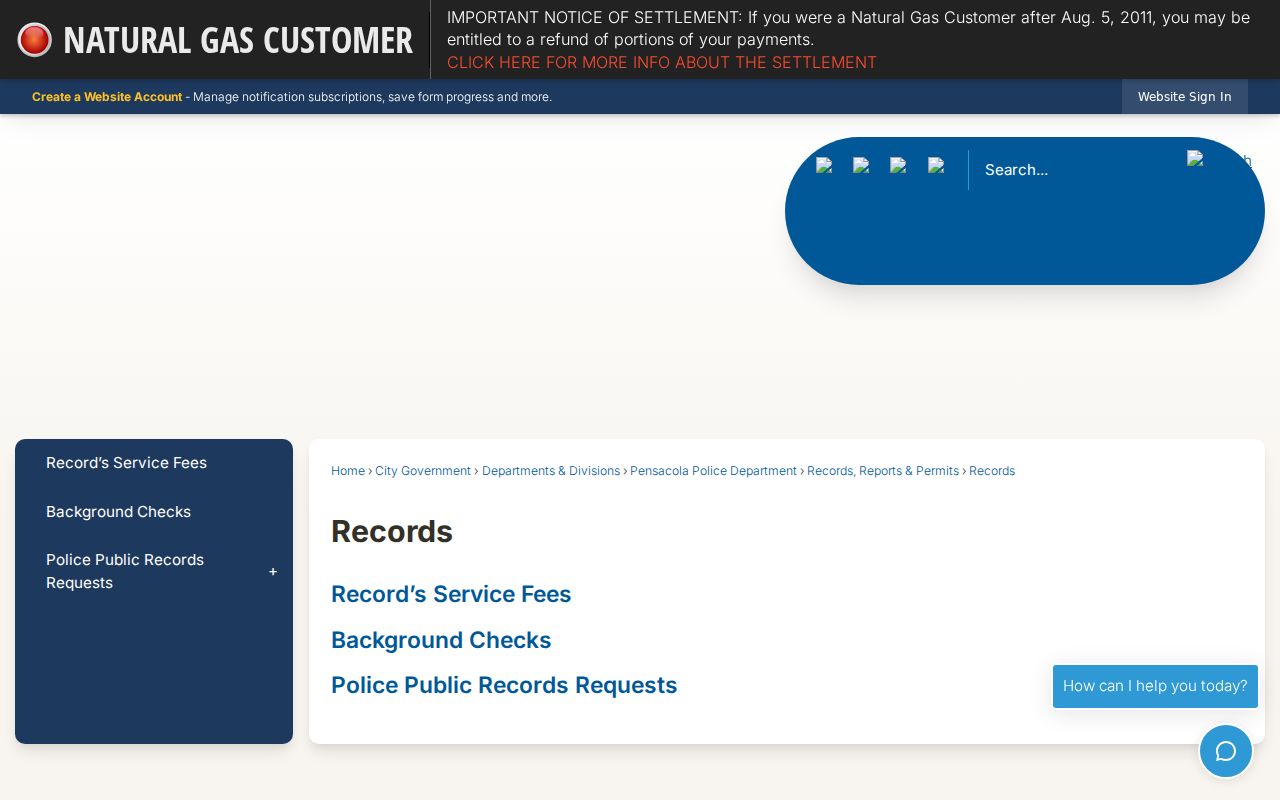
The page identifies the correct city route and helps prevent a PPD record request from being sent to the county sheriff.
Booking and Arrest Records in Pensacola
Pensacola arrestees generally enter Escambia County Corrections at 3080 N. Pace Boulevard. JAIL View can show a PPD booking with the arresting agency, booking date, charges, custody, bond, and holds. That booking is a Corrections intake record, not the PPD narrative and not the final court judgment.
A booking may appear before the State Attorney files a case. Charges can change after review. A municipal citation without custodial arrest may never create a JAIL View entry, so the jail portal is not a complete Pensacola city-case search. For a detailed county booking workflow, use the Escambia County arrest search.
A Pensacola Arrest's Route to Court
The first record often starts with a PPD officer's report. County Corrections then creates a booking entry if the person is taken into custody. The State Attorney decides what state charges to file, and the Escambia Clerk opens the County Court misdemeanor or Circuit Court felony case. The resulting disposition is reported through Florida's criminal-justice system to FDLE when required.
Record flow: Pensacola Police Department › Escambia County Corrections › Escambia County Courts › Florida Department of Law Enforcement
This flow explains why an arrest allegation and a later filed information can differ. Read the CourtView docket through judgment rather than treating the first charge row as the final result.
The Pensacola Municipal Court File
Pensacola Municipal Court handles municipal ordinance matters within its lawful jurisdiction. It is not the felony court, and it does not replace Escambia County Court for state misdemeanors. Use the City's Municipal Court page for current judge, session, payment, and contact information. Use Clerk CourtView when the case is a state misdemeanor or felony.
| Court | Pensacola Municipal Court |
|---|---|
| Case scope | Municipal ordinance matters within city jurisdiction |
| Lookup channel | Official Municipal Court page and current city contact process |
| County cases | Escambia CourtView for state misdemeanor and felony matters |
| Copies and fees | Confirm the current city process and product charge before ordering |
The official Pensacola Municipal Court page is shown in the source capture.
The city page is the right first stop for ordinance matters, while county criminal files remain with the Escambia Clerk.
Search Pensacola CourtView After Booking
After enough time has passed for filing, search Escambia CourtView by name, case number, or citation. A CF code commonly identifies a Circuit Criminal felony file, while MM commonly marks a County Criminal misdemeanor. Confirm the person by more than name, then read filing date, court, charges, events, judgment, sentence, and status.
CourtView is free and detailed, but its online information is not an official certified record. A closed label does not tell whether the case ended in conviction, dismissal, acquittal, or another outcome. The docket events and disposition fields answer that question. Request a certified copy from the Clerk when an official document is needed.
When the online docket lists a document but does not display it, use the Clerk's copy or viewing request route. Describe the docket title and date instead of requesting an entire file. Certification, copying, and other Clerk products can carry separate charges under Florida law, so ask for a quote. A document mentioned in a PPD report may never have been filed with the court.
Downtown Pensacola Criminal Record Geography
Pensacola records are close in distance but divided by office. PPD is on Hayne Street. The M.C. Blanchard Judicial Building at 190 W. Government Street is the main criminal court and Clerk destination. ECSO is at 1700 W. Leonard Street, and County Corrections is at 3080 N. Pace Boulevard. Going to the nearest building can still mean going to the wrong custodian.
The City's naval, port, and tourism setting can also produce state, federal, or military layers. Federal criminal cases use the Northern District of Florida and PACER, not CourtView. Military matters are not ordinary Escambia Clerk cases. FHP-origin reports remain with FHP even if county booking followed.
How Pensacola Records Reach the County
PPD retains the city investigative file. Once prosecution begins, filed pleadings, hearing events, pleas, judgment, and sentence belong to the Clerk's county court file. Qualifying arrest and disposition information can then reach FDLE's state repository. Each layer serves a different role, and one cannot safely stand in for all the others.
A recent incident is best checked with PPD and JAIL View. An older prosecuted case is best traced through CourtView. A statewide name-based product comes from FDLE, while a free personal review uses fingerprints and is restricted to the subject or designated attorney. Keep county and state detail at that level unless the wider history is truly needed.
Pensacola Body-Camera Request Details
Audio and video requests can require more staff time than a short report. Give a narrow date, approximate time, exact location, event description, and officer or report number if known. Specify the segment sought. Broad requests can trigger extensive review and redaction labor, while a focused request helps the City locate the right file and estimate cost.
Florida exemptions can protect active-investigation details, juveniles, victims, medical facts, and portions of audio or video. If material is withheld, a requester can ask the custodian to identify the legal exemption. A redacted PPD file does not mean the same information will appear remotely in CourtView.
Pensacola Record Access Rules
Florida's Constitution and Chapter 119 begin with broad public access, but specific exemptions and court-access standards control what is released. A custodian must allow inspection and copying at reasonable times and under reasonable conditions. Ordinary copying charges and a special service charge for extensive technology or labor may apply. Florida requires a prompt response, not a fixed deadline chosen by the requester.
Key statutes:
Florida Statutes 119.07 sets inspection, copying, fee, and response duties for public records.
Florida Statutes 119.071 contains exemptions that can protect active investigative and sensitive information.
Florida Statutes 943.053 governs public dissemination of state criminal-history information.
Ask for an estimate before costly work and identify the exact product. A Pensacola city request cannot compel the City to produce an ECSO, Corrections, Clerk, or FDLE record it does not maintain.