
Century Criminal History Checks
The correct Century starting point depends on the record. An incident or arrest narrative normally belongs to ECSO Criminal Records. A new booking appears in county JAIL View. A filed state misdemeanor or felony appears in Escambia CourtView. The Clerk's Century location can help with court access, while FDLE and FDC cover statewide history and state custody.
- Request the ECSO-origin incident or arrest report from Criminal Records.
- Search Escambia County JAIL View for booking and current custody.
- Search CourtView by name, case number, or citation for the filed case.
- Use the Clerk's Century counter for available north-county copy or filing help.
- Use FDLE for statewide history and FDC for state prison or felony supervision.
Century has no city police step and no town criminal docket to search. Replacing those nonexistent channels with official county routes is essential to a truthful Century record check.
Century Has No Separate Police Department
ECSO supplies general law-enforcement service inside Century. An incident in town therefore normally routes to ECSO Criminal Records, not to a Century police records unit. ECSO maintains arrest reports, offense reports, booking prints, miscellaneous offense paperwork, investigative files, and local criminal-history material that it created.
Criminal Records can be reached at 850-436-9501 or fax 850-436-9784, and the official online request center is another route. Include the report number if known, incident date and time, location, involved names, the exact product sought, and a delivery choice. The town government does not become custodian merely because the event happened within town boundaries.
ECSO Criminal Records
1700 W. Leonard Street
Pensacola, FL 32501
850-436-9501
Fax 850-436-9784
Century Town Records Are Different
The Town of Century maintains town-government materials such as minutes, ordinances, and utility records. Those are public records, but they are not a substitute for an ECSO report, Corrections booking, or Clerk criminal case. A request sent to Town Hall should concern a record the town actually made or received.
The Town of Century official gateway is shown in the source capture below.
The town source is useful for municipal government records, while criminal investigative records remain with ECSO.
Records at Century's ECSO Service Area
ECSO precinct service explains the local enforcement route, but records requests still go through the Sheriff's official Criminal Records channel. The public records counter is not a town police office, and County Corrections is a separate custodian for booking. This division keeps the narrative, custody entry, and court file in different systems.
The Sheriff's official precinct page documents ECSO service across the county.
The precinct source supports the county service route without implying that Century operates its own department.
Booking and Arrest Records in Century
A new Century arrest is booked through Escambia County Corrections, not a town jail. Search county JAIL View for the booking date, custody status, arresting agency, listed charges, bond, and holds. The entry may appear before the State Attorney creates a court case. It records the intake allegation and custody event, not guilt.
Request the narrative from ECSO even when JAIL View supplies the booking. After filing, search CourtView for the actual charge and later disposition. If the person has moved to state prison or felony supervision, use FDC Offender Search. These transitions can make a name disappear from current county custody while a court or state record remains.
Century State Prison Is Not the County Jail
Century Correctional Institution is a Florida Department of Corrections state prison. It is not a Century municipal jail and not the Escambia County Correctional Facility. A search result containing the word Century can therefore describe a state institution rather than a local arrest.
| Question | Official source | Meaning |
|---|---|---|
| New arrest in Century | Escambia JAIL View | County booking and custody |
| Incident narrative | ECSO Criminal Records | Sheriff-created report |
| State sentence or supervision | FDC Offender Search | Florida prison or felony supervision |
| Filed criminal case | Escambia CourtView | County or Circuit Court docket |
Match the agency and custody type before concluding that a record concerns a Century arrest. The institution name alone does not establish where the offense or court case began.
The Century Municipal Court File
No separate Century municipal criminal-case database or municipal criminal court portal was identified. State misdemeanor and felony cases from Century belong to Escambia County Court or the Circuit Court of the First Judicial Circuit. CourtView is the online search, and the Escambia Clerk is the custodian.
| Town criminal portal | None identified in official sources |
|---|---|
| State misdemeanor court | Escambia County Court |
| Felony court | Circuit Court of the First Judicial Circuit in and for Escambia County |
| Online lookup | Escambia Clerk CourtView by name, case number, or citation |
| North-county counter | Escambia Clerk location at 7500 N. Century Boulevard |
Century's lack of a municipal criminal portal is not a gap to fill with a third-party site. It means the official county chain is the correct answer.
Use Century's Clerk Counter Carefully
The Clerk lists a Century service location at 7500 N. Century Boulevard, Century, FL 32535. It gives north-county residents a local counter, but the main criminal court remains the M.C. Blanchard Judicial Building in Pensacola. Confirm which copy and filing services are available in Century before travel. A specialized proceeding may still require Pensacola.
The official Escambia Clerk locations page is captured below.
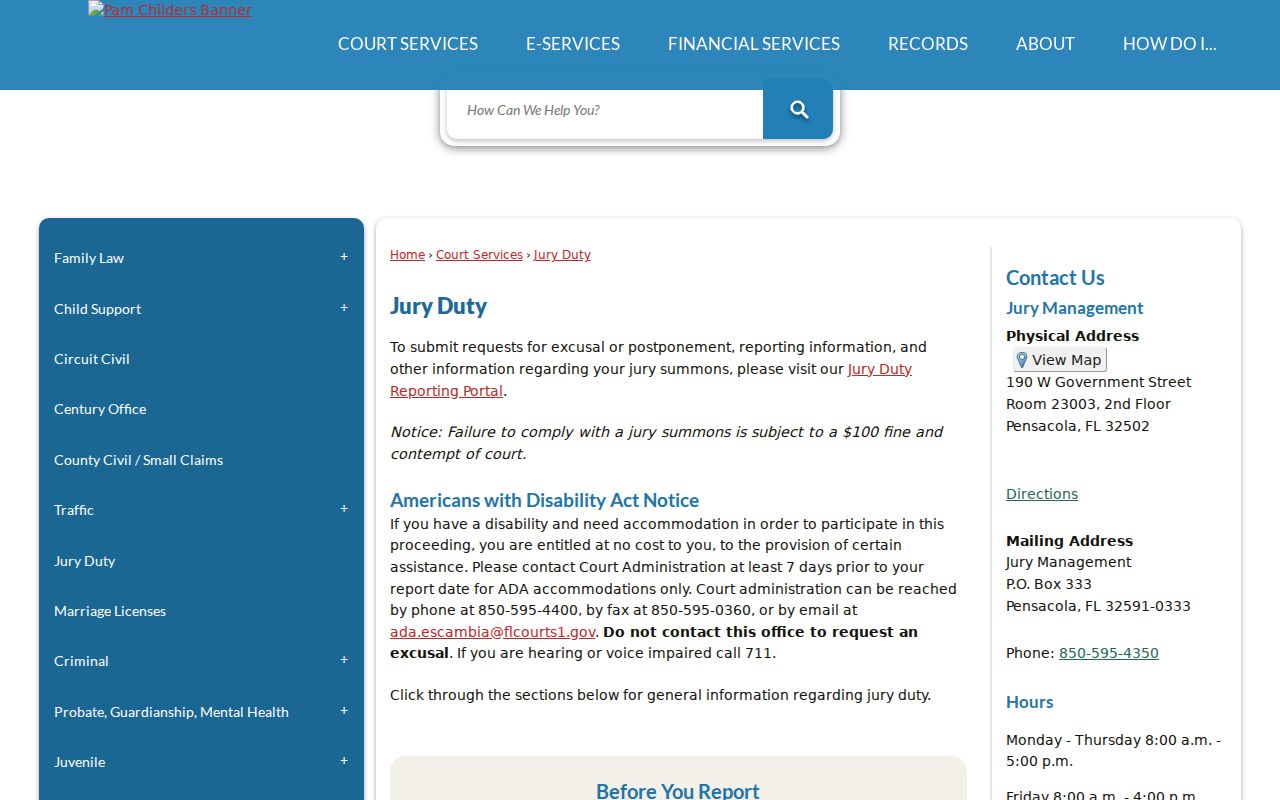
The live locations page is the best source for current counter functions and hours.
Track a Century Felony in CourtView
Search the Escambia Clerk's CourtView by name, case number, or citation. A CF code commonly indicates a Circuit Criminal felony, while MM commonly indicates a County Criminal misdemeanor. Compare the party, filing date, court division, and case number rather than accepting a name match alone.
Read the charge, docket events, hearings, plea, judgment, sentence, and status. A booking charge may change when the State Attorney files. A closed label does not tell the final result, and an online warrant or capias event is not real-time warrant clearance. For the full county process, the Escambia County court case lookup explains CourtView and certified-copy routes.
The Clerk, not ECSO or the trial judge, is custodian of the filed Century case. The State Attorney controls its prosecutorial work file, and ECSO controls its investigative report. A discovery item can be referenced in court without being remotely displayed or filed as a public document. Request the exact docket item from the right office when CourtView alone is not enough.
How Century Records Reach the County
ECSO keeps its investigative report, County Corrections creates the booking entry, and the Escambia Clerk keeps the filed court case. Qualifying arrest and disposition information can then reach FDLE. A prison sentence or felony supervision creates an FDC record. Century town government is not in that criminal-record flow.
Record flow: ECSO service in Century › Escambia County Corrections › Escambia County Courts › Florida Department of Law Enforcement
For a recent event, begin with ECSO and JAIL View. For the final prosecuted outcome, follow CourtView through disposition. For statewide history, use FDLE. Each step answers a narrower question than the phrase criminal history suggests.
Florida or Alabama Escambia County?
Century lies at the Alabama line, and both Florida and Alabama have an Escambia County. Check the state name, agency seal, web domain, and court terminology before relying on a result. Florida's Escambia CourtView uses Florida Clerk and First Judicial Circuit labels. Alabama uses a different judiciary and different official sites.
Add Florida to a Century search and verify that the record names ECSO, Escambia County Corrections, the Florida First Judicial Circuit, FDLE, or FDC as appropriate. A same-name county result from Alabama should not be blended into a Florida history.
Location words inside a result are not enough. Century can also appear as the name of the Florida state prison. Compare the arresting agency, court, county and state, custody system, and case number. If those fields point in different directions, return to the official source rather than trying to merge records based on a shared name.
Century Warrant Questions Need Verification
CourtView may show a capias or warrant event, but its public docket is not definitive active-warrant clearance. When the public case record is unclear, contact the ECSO Warrants Unit at 850-436-9523 or the issuing court. The reviewed official site did not provide a public name-based Century warrant portal.
Do not interpret a blank search as proof that no warrant exists. Sealed records, juvenile matters, recent changes, and data lag can limit public results. Warrant, bond, and surrender terms come from the issuing court and law-enforcement authorities, not a generic list.
ECSO maintains warrants with the Clerk and State Attorney, enters them in criminal-justice databases, conducts fugitive work, and handles extradition. Those functions are countywide. Century does not maintain a parallel warrant unit, public town list, or separate verification number. A focused call should include the case number and issuing court when known.
Century Record Access Rules
Florida's constitutional access right and Chapter 119 cover records held by the town, ECSO, Corrections, and other public custodians, but the request must go to the office that maintains the item. Section 119.07 permits inspection and copying under reasonable conditions. Ordinary copy charges and special service charges for extensive labor or technology may apply.
Key statutes:
Florida Statutes 119.07 governs inspection, copying, fees, and prompt public-record responses.
Florida Statutes 119.071 protects specified active investigative and sensitive information.
Florida Statutes 943.053 controls dissemination of Florida criminal-history information.
Juvenile facts, victim information, medical material, and active criminal investigative or intelligence information may be withheld or redacted. Ask for a cost estimate and the legal basis for any deletion. Florida requires a prompt response, not a requester-imposed fixed number of days.